


Shipping containers are lifted millions of times each year in ports, terminals, warehouses and project cargo operations. While container handling may appear straightforward, incorrect lifting methods can damage the container structure, create unsafe lifting conditions and potentially lead to catastrophic failure.
This article explains the approved methods for lifting ISO shipping containers, why spreaders are generally preferred, and which alternatives can be used when a spreader is not available.
A typical 4-legged sling, attached to the four top corners of a container induces compression loads in the roof plane of the container, especially lengthwise. Containers are not designed to take this compression load at the roof plane in a lengthwise direction. The actual strength of the roof varies from container to container, depending on the manufacturer, age, size ... Therefore it is possible that several lifts are made with only a 4-legged sling, and that no particular problem is noticed.
The operator is lured into believing that this is a safe way of handling the containers.
However, due to this practice, unseen damage is done to the container and every lift can lead to the instant breaking of the container.
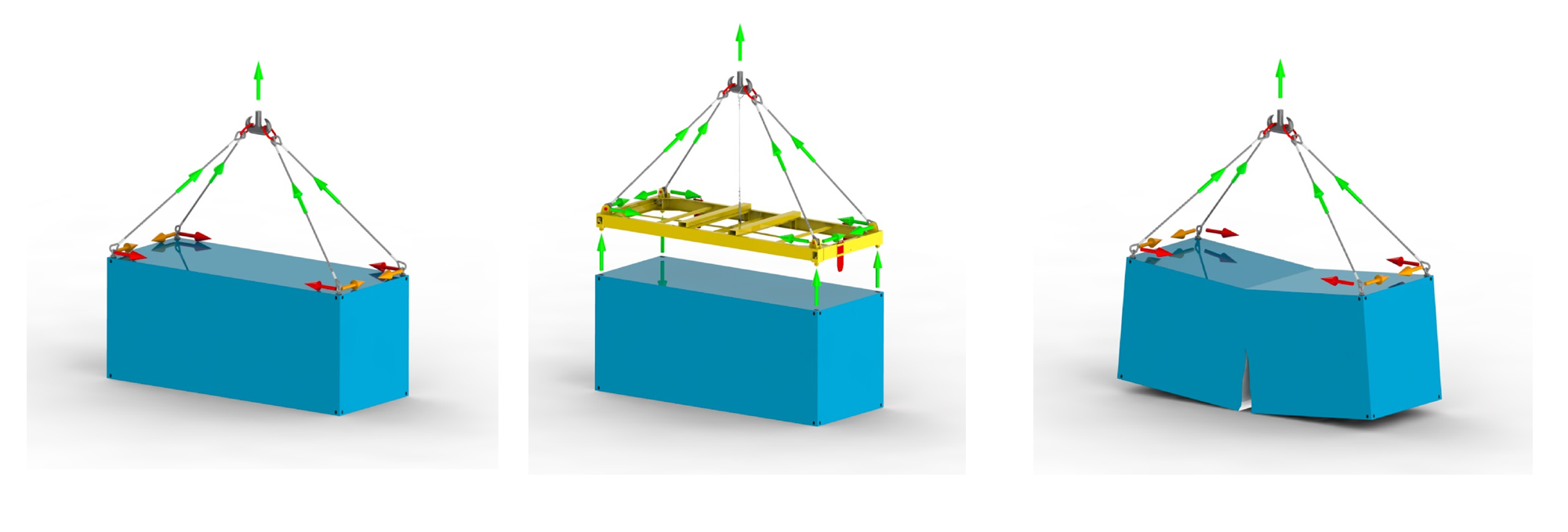
When using a spreader like the MK-20 or MK-40, the compression load is no longer induced on the roof of the container, but directly on the spreader (which is designed for this load).
The top frame of the container is thus free of compression loads.
The container is now lifted vertically, which is the only configuration for top lifting, allowed by the international standard (ISO 1496). The use of a (semi-automatic) spreader also has several other advantages, such as quicker handling of the containers and less operators required.
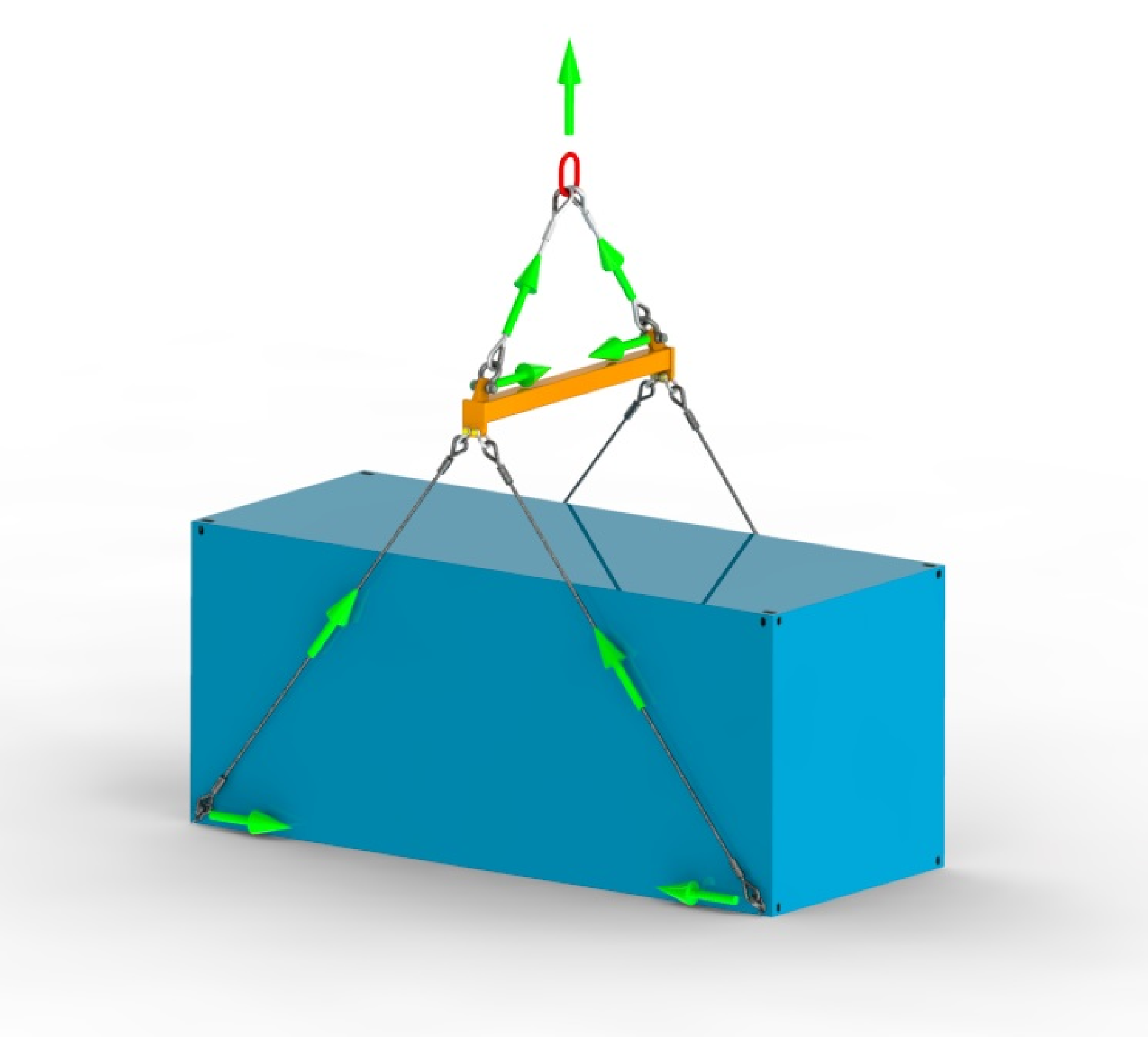
There is still a possibility to lift a container without a spreader, using bottom lifting parts such as MK-5L & MK-5R. These parts fit the side holes of the bottom corners of the container. In this case, the compression load in a lengthwise direction is taken by the floor frame of the container, which is a lot stronger than the roof plane.
The transverse compression load is absorbed by the crossbar. This method of lifting is also mentioned in the ISO 1496 standard.
Another advantage of this system is that the required lifting height is in most cases less than when using a spreader.
Shipping containers are lifted millions of times each year in ports, terminals, warehouses and project cargo operations. While container handling may appear straightforward, incorrect lifting methods can damage the container structure, create unsafe lifting conditions and potentially lead to catastrophic failure.
This article explains the approved methods for lifting ISO shipping containers, why spreaders are generally preferred, and which alternatives can be used when a spreader is not available
Depending on the application, containers can be lifted using:
The choice depends on container size, available lifting height, crane configuration, cargo weight and operational requirements
ISO containers are designed so that lifting forces are transferred through the corner castings and corner posts. These structural elements are specifically designed to withstand stacking, lifting and transport loads.
Any lifting method that introduces unintended compression or bending loads into other parts of the container structure may result in permanent damage or reduced structural integrity.
This is why approved container lifting systems always transfer loads through the designated corner fittings.
The lifting methods described in this article are based on the structural principles of ISO containers and lifting configurations referenced in ISO 1496. Container lifting equipment should always be selected and used in accordance with applicable regulations, manufacturer instructions and local safety requirements.
Direct top lifting with a four-legged sling can introduce compression loads into the container roof structure. In most situations, a spreader should be used to transfer loads correctly through the corner castings.
A spreader keeps the lifting forces vertical and prevents compression loads from being introduced into the roof structure of the container.
Yes. Bottom lifting systems can be used in certain situations where a spreader is not available or where lifting height is limited.
The preferred method is lifting through the corner castings using an approved container spreader or other purpose-designed container lifting device.
ISO 1496 specifies structural requirements and approved lifting configurations for ISO containers
Please enter your contact details and query below and our team will reply to your request today. Fields marked * are required

In our free e-catalogue , you will find all the info and photos about our solutions for fixed lashing, loose lashing, lifting and rigging gear. Fill in the form below and you will receive your e-catalogue quickly.

