


Maritime wind turbine blade transport involves the shipment of extremely long, lightweight, and structurally sensitive components by sea. Due to their length, flexibility, and susceptibility to deformation, wind turbine blades require dedicated securing and support solutions to ensure safe transport during maritime voyages.
Unlike conventional cargo, wind turbine blades combine low weight with very large dimensions, making them vulnerable to bending, torsion, and surface damage when exposed to dynamic sea forces. Proper load distribution, controlled contact points, and certified lashing systems are therefore essential to prevent structural damage throughout the transport process. To meet these challenges, industry leaders rely on the CONTECH® T‑12 double twistlock, a proven solution designed specifically for securing large wind‑blade transport frames. The T‑12 has been used extensively by major turbine manufacturers and shipping operators, demonstrating exceptional reliability, stability, and ease of use during the maritime transport of wind turbine components.By ensuring secure interconnection of blade‑transport frames, the T‑12 significantly enhances safety, stacking efficiency, and structural integrity during shipping operations. Its robust design reduces the need for additional lashing equipment, speeds up loading processes, and supports the logistics demands of today’s large‑scale wind energy projects.
As the wind sector continues to grow, CONTECH® remains committed to delivering certified, high‑performance lashing and securing solutions that support the global energy transition and guarantee the safe transport of next‑generation wind turbine blades.
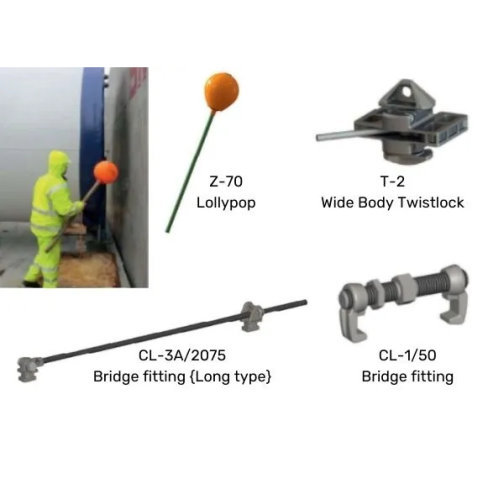
Transporting wind turbine blades by sea presents several technical challenges:
These factors make standard container or breakbulk securing methods unsuitable. Each shipment must be engineered to maintain blade geometry and prevent deformation during loading, transport, and unloading.
These conditions requires different securing methods and equipment, including lashing chains, D‑rings, twistlocks, webbing straps, lollipop fenders.
Together, they ensure safe, efficient transport of wind‑turbine components across road, port, and sea logistics.
For maritime transport, wind turbine blades are typically supported on custom blade saddles or cradles that distribute loads evenly along the blade length. Certified marine lashing systems are used to secure the blades while allowing controlled movement where required, avoiding stress concentration.
Key principles include:
Container Technics supports wind turbine blade transport projects by supplying engineered lashing and securing solutions designed for oversized and project cargo shipments, ensuring safe and efficient maritime transport of wind energy components.
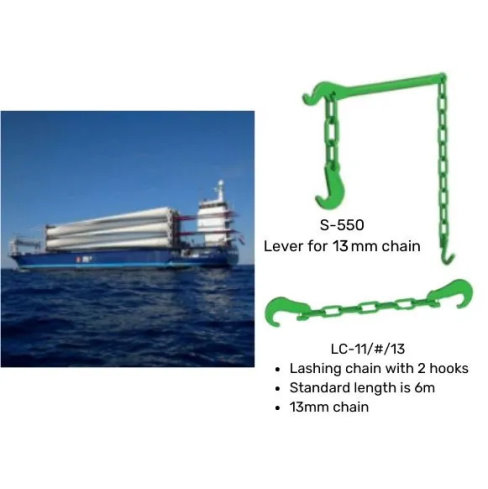
The CONTECH® double twistlock T‑12 is engineered for heavy‑duty securing of wind turbine components and is available in multiple sizes to fit different transport frames. It has proven its reliability during numerous shipments of wind turbine blades, nacelles, and tower sections, used by leading manufacturers and shipping companies worldwide.
In recent years, hundreds of wind‑energy components have been safely transported using Contech lashing solutions—including the T‑12 double twistlock, lashing chains, webbing straps, and bridge fittings. The T‑12 ensures fast, stable, and compliant locking between transport frames, making it an essential tool for modern wind‑energy logistics.
For operation, maintenance, and technical details of the T‑12, you can read more in this blog.
Maritime transport of wind turbine blades is complex because blades combine extreme length with low structural stiffness. Although lightweight, they are sensitive to bending, torsion, and localized pressure. Dynamic forces during sea transport can introduce stresses that are not immediately visible but may affect blade integrity during installation or operation.
Wind turbine blades are secured using engineered support systems such as blade saddles or cradles that distribute loads evenly along the blade length. Certified marine lashing systems are applied to control movement while avoiding stress concentration, ensuring that blade geometry is maintained throughout the voyage.
The main risks include deformation caused by uneven support, damage from point loads, and cyclic stresses generated by vessel motion, wind, and waves. These risks are managed through project‑specific securing designs that take into account blade dimensions, vessel characteristics, and transport conditions.
Always available from stock.
It can be shipped worldwide.
There are about 20 types of Twistlocks.
Twistlocks are used to connect containers together in their stack.
Please enter your contact details and query below and our team will reply to your request today. Fields marked * are required

In our free e-catalogue , you will find all the info and photos about our solutions for fixed lashing, loose lashing, lifting and rigging gear. Fill in the form below and you will receive your e-catalogue quickly.


